“We deserve to die for our crimes, but this man hasn’t done anything wrong.” Luke 23:41 (NLT)
“It was not because of his sins or his parents’ sins,” Jesus answered. “This happened so the power of God could be seen in him.” John 9:3 (NLT)
23 One person dies in prosperity,
completely comfortable and secure,
24 the picture of good health,
vigorous and fit.
25 Another person dies in bitter poverty,
never having tasted the good life.
26 But both are buried in the same dust,
both eaten by the same maggots.27 “Look, I know what you’re thinking.
I know the schemes you plot against me.
28 You will tell me of rich and wicked people
whose houses have vanished because of their sins.
29 But ask those who have been around,
and they will tell you the truth.
30 Evil people are spared in times of calamity
and are allowed to escape disaster. Job 21:23-30
This morning I was sitting at my dining room table eating French toast and trying to explain Good Friday to my eight year old. “This is the day Jesus died on the cross,” I said to her. “We say thank you for his sacrifice even while we feel sad that our beautiful Jesus had to die so we could live.” She nodded. “What time did he die?” she asked, ever grasping for the concrete. “Well, should we read about it?” I said, not trusting my own memory of the details.
We went through the gospel account in Mark, and I showed her where it said he was crucified at around nine in the morning, but he did not die until three in the afternoon. “What is crucified?” she said. “Nailed to the cross,” I answered. I explained that the Romans were a cruel people who had learned the delicate science of delaying death to maximize suffering, how they did not mean for Jesus to die quickly, but for him to suffer as much as they could make him before he died. “He wasn’t the only one who died this way,” I explained. I told her about the criminals who were also crucified that same day, one on either side of Jesus. “They died because they had hurt other people.”
“I would have wanted to make them suffer too,” she said vengefully. “They did bad things.”
The wisdom in me chafed at her unaware confession. I am her mother. I have lived with her every day of her life. I know what patterns of bad behavior she embraces, what crimes she has committed, how many people she has hurt. Would she feel the same if she recognized her own crimes? Few of us do. I wanted to immediately snuff that sentiment, grab her pencil and erase the mistake for her, rebuke the childish words. But as I sat there contemplating my next words and choosing to be honest with myself, there are times I have understood the flood better than the cross, too.
“A lot of people feel that way,” I said instead. “But do you know what Jesus did?”
I read the rest of the story to her. I read about how one of the criminals had mocked Jesus, but the other – the other understood the world in a way few people do. Maybe it was because he knew he had hurt innocent people. Maybe he had seen things in the social circles he had traveled. Maybe he had been watching Jesus, sneaking away to listen to Jesus teach when his buddies weren’t around, or listening to the rumors and noticing how unusual they were. Maybe he knew someone Jesus had healed – maybe a friend, maybe family, maybe another criminal he knew did not deserve it. Maybe someone had been planting seeds in his heart. Or maybe he just knew criminals well enough to know that Jesus was nothing like them. However he knew it, he knew Jesus was innocent.
Why is that so unexpected? Maybe you wonder. Of course Jesus was innocent. We all know that.
But they didn’t. And anyone who thought he was innocent would be questioning how much they really knew about him when they saw him hanging on that cross, because there is one belief deeply rooted in human hearts the world over that would condemn him just for suffering: input equals output.
We call it karma. We call it fair. We call it the will of “the universe.” Buried in the heart of every religion save one is this belief that people get what they deserve. If we do good things, we get good things. If we do bad things, we get bad things. It is equal. It is balanced. It is a delusion.
I have been pondering this idea of an equal and balanced world for many months as I have been studying through Job. It is the philosophical question that had four of the world’s wisest old men sitting in dust and ashes and harshly arguing for days: “Do people always get what they deserve?” Three said yes. One, one only, said no. And God backed him up. Why?
Because you have to acquit a Job to allow a Jesus.
The Pharisees and many of the religious teachers of Jesus’ time taught that good comes to good, bad comes to bad. Often God does use circumstances to discipline and correct his people, and it is his right and his wisdom to do so. But. When we humans start to assume we understand God’s parenting methods without actually staying in communication with him – well. We DO. NOT. God’s ways are not our ways. The only way to understand God’s actions is to listen to what he says. Not just the part we like, or the part that is easy. All of it. That is what the Pharisees and religious teachers had not done. They had ignored Job. They taught people that good things come to those who do good and bad things come to those who do bad. In this way, they, the wealthy, well-regarded, and prestigious of society, puffed themselves up with the belief that they had gotten what they deserved. They looked down their noses at the suffering and accused them of hidden sin, which in their minds released any responsibility they had to help those “sinners.” They used it to excuse and support their own selfishness. How far from the heart of God they had slipped!
But the thief on the cross?
Oh, wouldn’t the leaders be humiliated to find out that he understood God better than they did. Wouldn’t they be humiliated to find that he feared God like they did not. For it was he who recognized that the world is not equal and balanced, he who saw how dangerously tilted the world had become, he who recognized the need for restoration of that balance – he who saw that Jesus had done nothing to deserve the suffering he received. But here is the miracle in the moment: he, like Job, still believed God is good.
And because he did fear God, the real God, who he would soon be seeing – he saw everything clearly. His own crime. Jesus’s innocence. God’s goodness. All of it true all at once – and he, like Job, saw the truth at last, that Jesus was the one who would restore the balance. That Jesus was the Savior, the Messiah, not of the Jewish political nation, but of the spiritually broken world.
Then he said, “Jesus, remember me when you come into your Kingdom.” Luke 23:42 (NLT)
What does it require, this salvation we profess? First, honesty – the acceptance that the world is not equal and not balanced, the deep conviction that something is wrong here that needs fixing, and the awareness that it is embedded within ourselves. Second, trust – the knowledge and belief that God is good even when circumstances are not. Third, insight – the perception of Jesus’s innocence despite his suffering that makes his sacrifice entirely miraculous, necessary, and stunning. And finally, the humility to ask for what we do not deserve. When we move through these revelations, we too hear what the clear-visioned criminal heard:
And Jesus replied, “I assure you, today you will be with me in paradise.” Luke 23:43 (NLT)
That was it. That was all. No baptism, no checklist of good deeds, no ritual, no dollar sign. At this moment the pillars of false religion crumble again and again. This man had to do nothing but be honest and tell the truth: he had sinned, Jesus had not, and he wanted to go with Jesus now. And Jesus said, “Of course you can come with me.” Job could not wait to go with Jesus, too. Abraham, David, Isaiah, Ezekiel – all of the others – all of them knew Jesus would come because they saw the imbalance, believed God was good, and knew he would do something about it. Their faith was always in God’s ability to fix what they could not. Their faith was always in Jesus, just the same as ours.
“Someday, maybe we will get to meet him in heaven,” I said to my little one about the criminal, about the Roman Centurion who saw what others did not, about all of the people who put their trust in the solid ground of God’s Son. I gathered up our plates and took them to the kitchen so she would not see the tears in my eyes as I imagined telling this criminal how much his words meant to me.
This belief that Jesus’s life and death demands from us is challenging and radically different than any other I have encountered in this world. It is counter-intuitive and undesirable. I do not want to believe I cannot control what happens to me. I want to believe that if I work very hard, I can get the reward of working very hard. It makes me furious when life does not turn out that way. But it does not, time and time again. That is what makes the Bible so completely trustworthy though, isn’t it? It tells us the truth whether we like it or not. And what makes it so profound, so beautiful, so miraculous? Not only does it tell us the hard truth, it tells us what God is doing about it. It shows us how when we are not, God is still good. His goodness is not dependent on ours. And though I think I want control… somehow finding out I am not responsible for making God be good… is such a relief. I may not always like his choices. But I can take my hands off the reins and let him make them because I know who he is. I can trust him to be himself. I can trust God to be good.
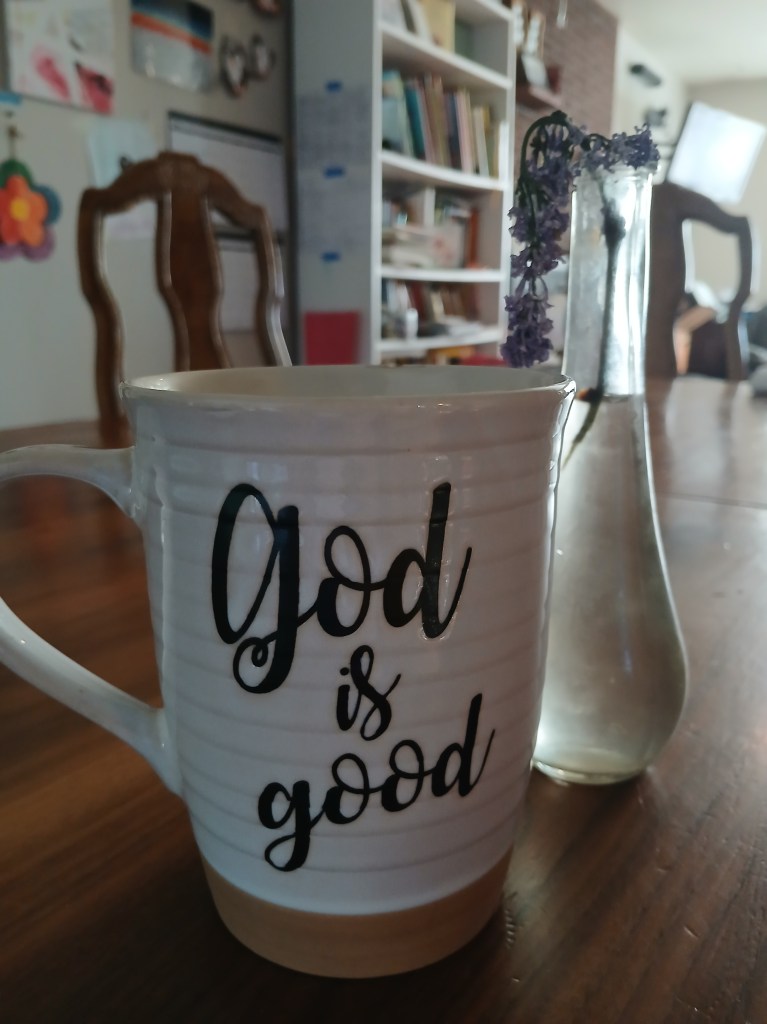
That is the whole difference between the Pharisees who nailed Jesus to a cross and the criminal who was nailed beside him; the Pharisees trusted themselves to be good, and the thief trusted Jesus. So this good Friday, I sit here and sip from this mug, ponder these droopy, dead lilacs and a dying Jesus taking the time to give the foundational belief of all false religion one last, big shake and wonder… which one am I today, Pharisee or criminal? Which one are you?
 onelittlewoman.com