Day 8: Yahweh Yireh

Then Abraham looked up and saw a ram caught by its horns in a thicket. So he took the ram and sacrificed it as a burnt offering in place of his son.  Abraham named the place Yahweh-Yireh (which means “the Lord will provide”). To this day, people still use that name as a proverb: “On the mountain of the Lord it will be provided.”

Genesis 22:13-14

God promised Abraham a whole nation of heirs long before he had even a single son. When God gave him Isaac, unbelievable Isaac, that was the end of it, right? The promise fulfilled, Abraham’s faith proved, everyone living happily ever after.

No, not quite. Too many people forget God the moment they get what they want from Him. Would Abraham? I think just to show us (and maybe Abraham himself) what this man’s faith was made of, God tested him. He asked for Isaac back. The thing – the one thing – Abraham had wanted more than any other, the one thing that had made him happier than anything else in all the world, God asked for back.

Hope deferred makes the heart sick, but a dream fulfilled is a tree of life.

Proverbs 13:12

God did not demand. He did not take, though He could have in a blink. He asked. All of the hope, all of the joy, all of the peace Abraham had felt since Isaac arrived – it would have made him sick, wholly and completely heartsick, to give up that son.

And what does Abraham do?

He doesn’t miss a beat. Isaac asks where the sacrifice is, and he says God will provide it. What he likely means is that God has provided it already – God gave him Isaac, and God asked for Isaac as a sacrifice.

Would you give back to God all that He has provided for you? ALL of it?

And then, in the moment of obedience, God stopped Abraham’s obeying hand (and Abraham obeyed again, probably a lot more easily this time!). God provided a ram instead. God praised him and blessed him for his obedience, and said, “THIS is why, Abraham. This is why the world is blessed through you.” Not because of his wealth, not because of his perfect parenting, not because of his moral compass, but because of his obedient faith. Because he would give back to God everything he had asked God to give to him. He trusted Him that much.

Abraham knew. Abraham had seen God take two bodies as good as dead and create a child from them. He had seen a miracle before, and he had not forgotten that GOD provides. And in that last possible second before he did the unthinkable, before he harmed his son and his own heart beyond human repair, God provided again.

Because that is who He is. It is His name, Yahweh Yireh. The God who provides. ❤

Thought seed: Do I trust God to provide again, even after He has already provided before? Or do I think I’ve reached the limit of His provision?

Day 7: El-Olam

After making their covenant at Beersheba, Abimelech left with Phicol, the commander of his army, and they returned home to the land of the Philistines. Then Abraham planted a tamarisk tree at Beersheba, and there he worshiped the Lord, [El-Olam].

Genesis 21:33-34

El-Olam: The Everlasting (or Eternal) God

It is one of the hardest lessons of our early lives, one I have repeated to my daughters at every broken toy, at the ending of every playdate, at the ruining of a favorite dress, at the death of a beloved dog, at the end of all the things they love that can’t go on forever: nothing lasts forever. This world was made a temporal and therefore temporary thing; all things fade, wear out, break, die.

Except.

There is one thing in this world, the only thing, we can love that will never fade, wear out, break, or die, and I tell my kids this too. The only everylasting, El-Olam, the everlasting God. The only Love we will ever have that will not end bereft.

I’m sure my kids think I’m crazy now, or dramatic, now when the world to them is so new and fresh and death is so far away it hardly seems real. But one day, perhaps they will remember. Nothing lasts forever, except.

Abraham knew this. By this part of his story, Abraham was an old, old man and had his promised son. But God had not ended there. The Lord had defended Him time and time again, including in this recent treaty of Beersheba, and granted him favor for his faith. His life was a story almost at its ending, and its “about” was growing clear: his life was a story about how who matters more than do. His faith was in Yahweh Elohim, Adonai, El Elyon, El Roi, the God he now knew by many names. The God who, throughout his whole life, never went away, but showed Himself present and active over and over again. The God who lasted though nothing else did; the everlasting God. And so he added a knew name that only a very old man can really know: El-Olam. The Everlasting God.

Nothing lasts forever except El-Olam.

Day 6: El Shaddai

When Abram was ninety-nine years old, the Lord appeared to him and said, “I am El-Shaddai—‘God Almighty.’ Serve me faithfully and live a blameless life.

Genesis 17:1 (NLT)

El Shaddai: God Almighty, All-Sufficient One

This is it. The moment God makes His covenant with Abram –> Abraham. The moment a 99-year-old childless man is promised a whole nation of heirs. The promise that made his wife laugh at its absurdity, and if we’re honest would have made most of us laugh too, but God fulfilled it. Because He is El Shaddai. He named Himself the Able One – the Able-to-do-Anything Almighty One – just a moment before He promised something no one else could promise. That deserves reiteration. Before He made the one of the most unbelievable covenants in history, God first said, “I can do anything.” He said so with His Name.

Thought seed: What can only El Shaddai accomplish in your life?

Day 5: El-roi

Thereafter, Hagar used another name to refer to the LORD, who had spoken to her. She said, “You are [El-roi].” She also said, “Have I truly seen [El-roi]?”

Genesis 16:13

El-roi: The God Who Sees Me

Hagar was a truly pitiable creature. She was a servant, given by her mistress to her mistress’s husband as an old-fashioned surrogate, of sorts. She had no choice and no hope; no choice to love, no choice to marry, no hope for a family of her own. Once she bore Abraham’s child, no one else would dare take her. Her dreams were usurped by someone else’s.

For a moment, though, she had power; for a moment, she was the woman who conceived when her mistress could not, proof that it was Sarai’s womb and not Abraham’s seed that was the reason they had no children. Sarai would have been considered cursed; she, blessed. Did she allow that thought to take hold in her mind? Is that why Sarai complained about her to Abraham, saying she had grown haughty and rebellious toward her mistress? Perhaps; though perhaps Sarai’s own sense of failure influenced her perceptions, too. Then again, maybe not. Maybe Hagar did step out of line. But did she deserve the full vent of Sarai’s wrath that she received for it? Unlikely. The Bible does not cover up Sarai’s harshness or try to justify it; there is jealousy here, fueling this rage. Jealousy that was not in the least Hagar’s fault.

But God is far from blind. Sarai was cruel, but God was kind. It was to Hagar He came, to her He spoke, to her He promised. Though to some extent she may have brought it on herself; though she was an Egyptian; though merely a servant in the chosen house; though her son was not the promised son, it was her God saw.

Never have I ever been invisible to God. <repeat>

There has been no darkness in my life His eyes did not penetrate, not even the kind I made myself. He is El-roi. He is the God Who Sees Me.

Day 4: Adonai

But Abram replied, “O [Adonai], what good are all your blessings when I don’t even have a son? Since you’ve given me no children, Eliezer of Damascus, a servant in my household, will inherit all my wealth.”

Genesis 15:2

Adonai: Lord, Master

Adonai. The name used instead of the Name. Jews frequently replace the Name of God – Yahweh – with Adonai when they come to it in the Scriptures. Adonai means lord or master, a token of deference and respect. Here Abram uses them both. ❤

“You’re the Boss, God,” Abraham says, right from the start. Abram had a complaint – but first, before he made it, he made sure to declare that whatever God decided, he would abide by. This was not a petty, spoiled Abram demanding more of a God who’d poured out blessing after blessing. This was Abram asking God for the one thing that was on his heart more than any other thing: a child. It was him saying, “God, I don’t want more things. What I really want is someone to love with them.” But if God still said no – He was Boss. (But, of course, this Boss is the One who gives good things to those who ask for them!)

Food for thought: Is God the Boss of my household? Is He the Boss of my life? Do I say, when I pray, “God, You’re the Boss?” and then follow through with obedience?

Day 3: El Elyon

And Melchizedek, the king of Salem and a priest of [El Elyon], brought Abram some bread and wine. Melchizedek blessed Abram with this blessing: “Blessed be Abram by [El Elyon], Creator of heaven and earth. And blessed be [El Elyon], who has defeated your enemies for you.”

And Abram replied to the king of Sodom, “I solemnly swear to the LORD, [El Elyon], Creator of heaven and earth, …”

Genesis 14:18-20, 22

El Elyon: The Most High God

Day 6: El Shaddai

Melchizedek is one of the more nebulous and fascinating characters in the Bible. He is mentioned so briefly as “the king of Salem,” and we know Salem means peace. He is “a priest of God Most High,” El Elyon. If he uses a different name for God, then how do we know his God was the same as ours? But Abram knew. El Elyon – Abram uses it too, beside God’s other name – The Name. Who is this man, and where did he come from? How did he know God? What was his relationship with the Lord like? And how did this man, mentioned so briefly in Genesis, become a whole order of priests-by-faith ordained by God rather than man or heredity?

I gave up my need to have all the answers a long time ago, so I won’t endeavor to answer what I do not know.

But this truth is here, plain-faced in Scripture: Melchizedek, whoever he was, wherever he came from, whatever he did next, loved the same God Abraham did, the same God who sent Jesus, Messiah, the same God we love today. He called Him El Elyon, the Most High God. The Best God, maybe. The Most Important God. The Ultimate God. The true God.

The God of all who seek Him.

Day 2: Yahweh Elohim

This is the account of the creation of the heavens and the earth. When [Yahweh Elohim] made the earth and the heavens, neither wild plants nor grains were growing on the earth. For [Yahweh Elohim] had not yet sent rain to water the earth, and there were no people to cultivate the soil.

Genesis 2:4-5

Yahweh Elohim: The LORD God

Yahweh is the name of God so revered the Jews would not even pen it fully. The Name of God is not to be used in vain, and to protect it from being so His chosen people would go to great lengths! They would write it in shorthand – something equivalent to Yhwh – because it was considered too holy to even be written out. It is the name “I Am,” the self-existent one, “The One Who was, Who is, and Who is to come.” It is the name I still wonder if I am wrong to spell fully (and I certainly mean to offend no one by doing so) or if I, too, in reverence should treat more carefully. Like calling a parent or a teacher by their first name, ought THE Name of God be reserved for those who are His equals?

But none are His equals, and it is His name. And if someone were to ask me whose daughter I am, I would give them my father’s name, though I call him “Dad” to his face. What I call God when I speak to Him and what I call God when I speak of Him may be likewise different. (?) But truth be told, I think God taught us His name because He wanted us to use it to call to Him. That sounds the most like something He would do.

Food for thought: in Genesis 1 as God is creating, He is called Elohim, but in Genesis 2 in which we see the whole story from a closer angle, He is called Yahweh Elohim. Is this to distinguish Him from all else – all else besides Him is created, but He is the self-existent Creator, the non-created among creation?

Day 1: Elohim

In the beginning, [Elohim] created the heavens and the earth.

Genesis 1:1

Elohim: God, the Creator

A writer friend of mine recently said, “I create because God creates.” I love that so much more than I can say. That we can imitate Him in creativity! That we can worship Him by creating!

I love it all the more because God created with words, and I love words. “God spoke” is scattered all over Genesis 1, and whatever God describes is. Fantasy writers use a term that has caught my fancy lately – they call their work “world building.” They, like God, build whole worlds out of words. Oh, to be blessed to imitate God in this way!

God is Creator, the World Builder. He is Elohim. ❤

Worship By Name Intro

Worship By Name Intro

Just recently, I began to feel prompted to return to an old prayer life habit I once had, long, long ago, in a land before children… 😉 Whenever I was anxious or stressed, I used to pray through this list I had of the Names of God. Well. I’m anxious. And I’m stressed! No time like the present.

The Bible study I’m a part of is studying Genesis right now. I decided to study it in a different version this time because I’ve been really enjoying the fresh set of eyes it gives me. Someone gave me a copy of the New Living Translation about a year ago, and I’m just loving it. ❤ This is what it brought out to me this week that I’d never seen before (just as I had begun to feel prompted to study this!): “At that time people first began to worship the LORD by name.” (Genesis 4:26b)

I think in the NIV, which is what I’ve mostly studied in the past, it says they first began to “call upon the Name of the Lord.” Which is all well and good, but it didn’t quite convey to me the same emphasis by name does. I was just thinking the other day how much respect we convey to someone when we know their name; it’s like saying, “You’re important. You’re important enough for me to remember your name.” And God – has a name. And not just one, no – He has many.

Like I was explaining to my daughter this morning, we all have many names, really. You might call me Carolyn, but my husband calls me Care. My parents call me Carrie, and my brother shouts “HEY CJ!” when I don’t answer to anything else (and I am gifted at tuning out!). My parents also call me by “my daughter,” my husband may say, “my wife,” my kids call me “Mom,” and my aunts and uncles call me “my niece.” Some define me. Some display relationship with me. They all describe me. They’re all mine.

God’s names are the same. They designate and describe and define Him, and they are one of many ways we can get to know who He really is. These are names people have called Him because of what He has done in their lives or what they have seen Him do in the world. His names are monuments by which to remember His actions (to remind us even that He is active!), which we humans too easily forget. They are handholds for us to grip Him by – He is vast, far vaster than any of His names, but they give us something we can hold onto.

I am going to spend 63 days (and have already started truth be told! This post is a little late) praying and studying the Names of God. I am going to journal it here, where I can come back to it and look at it again when I need to. You of course are welcome to join me! My posts will be short – maybe a paragraph or two – and focused exclusively on a single Name. Just a little seed of thought to water (meditate on) and allow to grow throughout the day. 🙂

And what’s a story like this without God inside and out? When I decided to do this, I thought I would stop at 30 days because that seemed a daunting enough commitment to me. BUT. God gently pointed out to me that I started exactly 9 weeks before Christmas. Studying 63 names. I don’t believe God does these sorts of things on accident. He knows I have loved Christmas, that it has often been a spiritually rich season for me as I meditate on His love, but these last few years have been dry. It’s like this – growing up, we always had live Christmas trees, the kind you have to water or they’ll dry up and drop their needles; well, my Christmases have been dropping their proverbial needles, and not because they’ve been any different than in years past but because I’ve been different – too busy. Unwatered. This year, God has put a full watering can in my hands and is nudging me toward the tree! I think He loves our Christmases together, too. ❤

So, all that to say I’ve given up my fear of committing and decided to dive into 63 days of worshipping God by name! 63 days of remembering who He is and why I have no need for worry. Who’s with me? 😀 Let’s go.

Then, turning to his disciples, Jesus said, “That is why I tell you not to worry about everyday life—whether you have enough food to eat or enough clothes to wear. For life is more than food, and your body more than clothing.  Look at the ravens. They don’t plant or harvest or store food in barns, for God feeds them. And you are far more valuable to him than any birds! Can all your worries add a single moment to your life? And if worry can’t accomplish a little thing like that, what’s the use of worrying over bigger things?

Luke 12:22-26

Faith Defiant

Faith Defiant

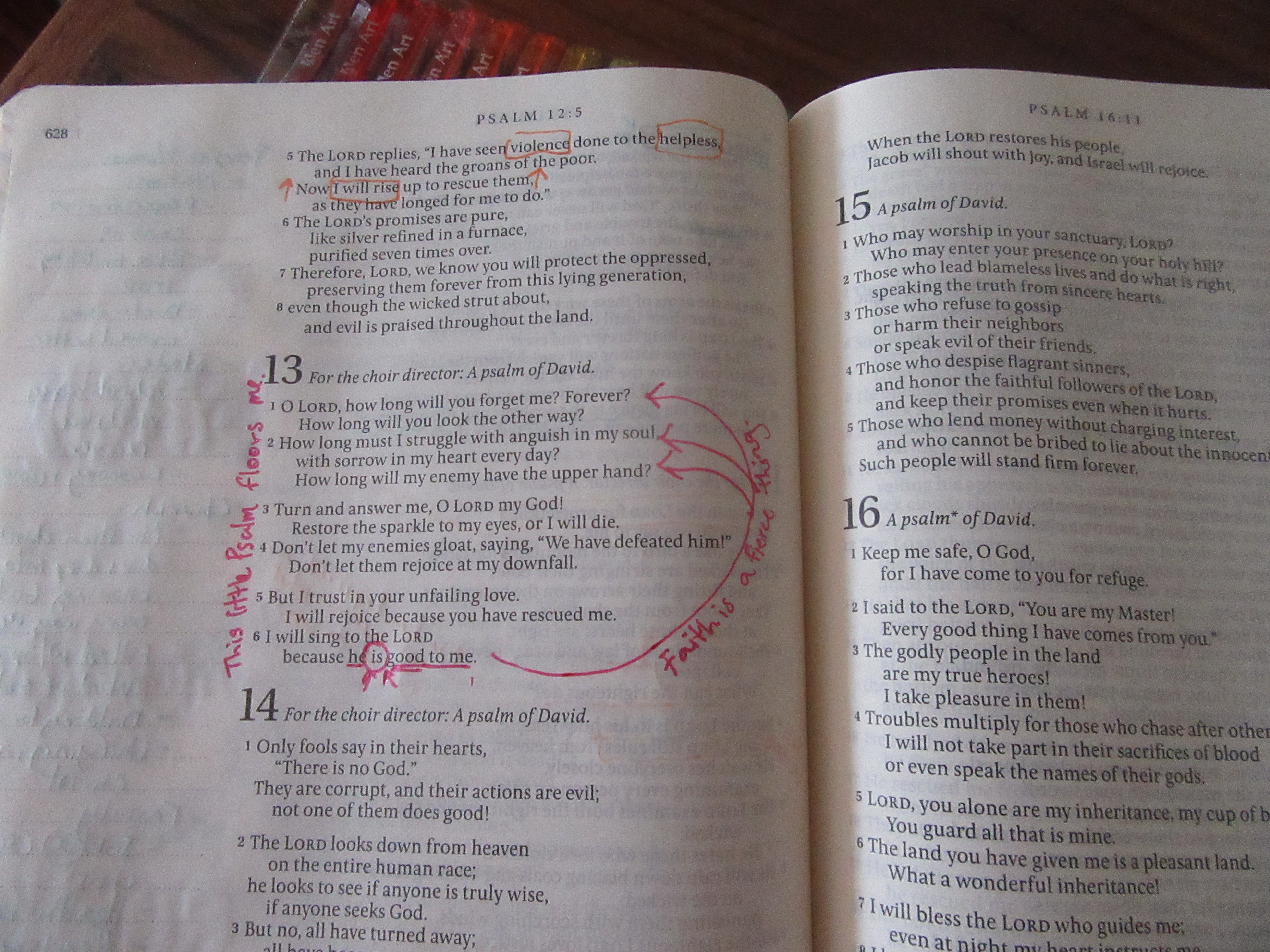
IMG_2464

I love the Psalms. Scripture is full of the external view of faith; what faith looks like on the outside, men and women who, in faith, see God part the Red Sea and raise their loved ones from the dead, who watch Jesus make water into wine and speak the seas into submission.

But the Psalms is a view of salvation, of faith, from inside a person. It is a written account of what it’s like, day to day, to experience the living, active God in the visceral world. It’s raw. No depth of despair, no venomous anger, no disappointment is left out. But the faith in the Psalms? It’s fierce. 

Take this little Psalm – Psalm 13 – for example. It opens in a desperate cry from one who feels forgotten. Beaten. Out of time. Hopeless and anguished.

And it ends with this defiance: “I will sing to the LORD because he is good to me.”

That declaration of faith downright defies circumstance. It is stubborn and fierce and refuses to budge in the face of appearances and the subsequent flood of emotions. It holds firm to its hope and will not give it up. It knows that when all looks hopeless and lost, God isn’t.

God isn’t hopeless. God isn’t lost. God is good. And I trust Him.

HUZZAH.

A faith defiant.

I love the Psalms!