Thursday: Love and Limits

Thursday: Love and Limits

“But why can’t I come now, Lord?” he asked. “I’m ready to die for you.”

Jesus answered, “Die for me? I tell you the truth, Peter—before the rooster crows tomorrow morning, you will deny three times that you even know me. (John 13:38)

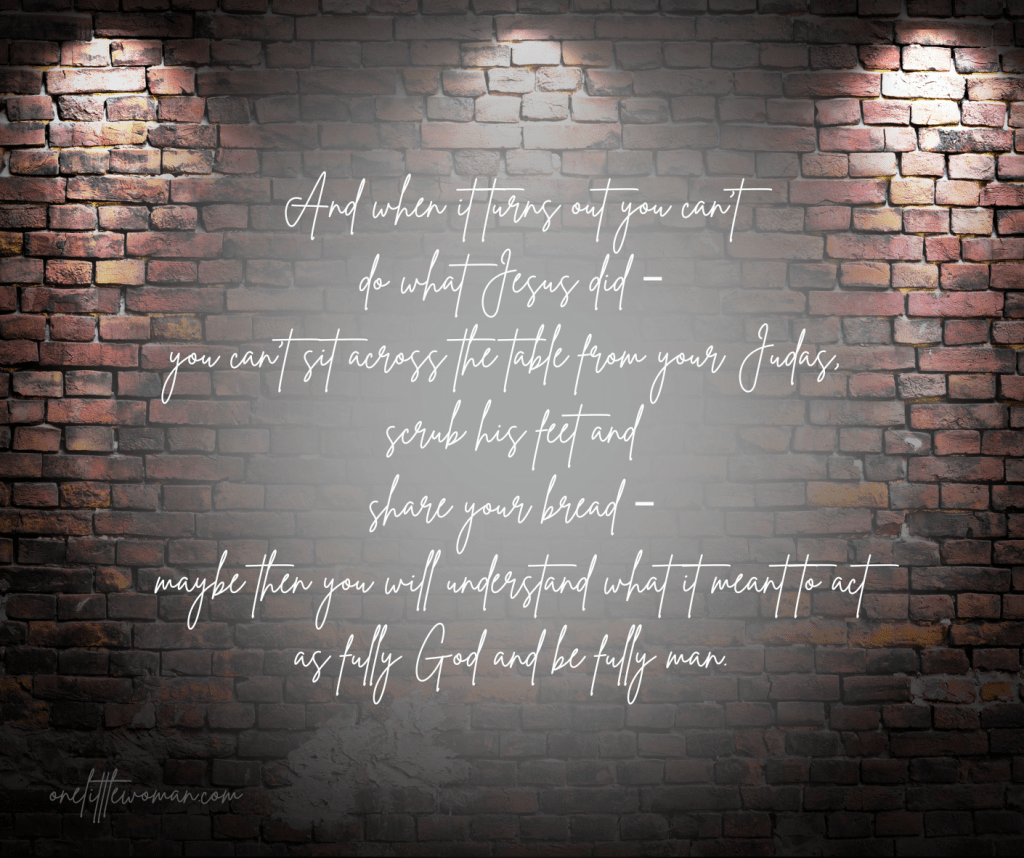
The Scriptures detailing the events and conversations that we now call Holy Week are some of the most rich and beautiful literature in existence. Do you realize how radical this conversation is? Do you realize how detailed, how well-preserved, how human and raw and real this record is! So much of our recorded history is glossy and air-brushed, altered to make our heroes look just a little more divine. What makes the Scriptures such an anomaly is this conversation exactly, the open acknowledgment that humans are weak of heart and riddled with chemical floods of emotion that make us act on instinct over principle. That Peter, who loved his Lord with all his being, who walked on water, who saw Jesus standing on a mountain with Moses and Elijah, who could hardly bear to have his feet washed, who in a peaceful moment meant to die in his place, would instead panic and self-preserve when the actual choice to die smashed through the wall of the theoretical and became reality. Peter. Even Peter.

Whatever boasts we are tempted to make about our own faith or abilities ought to fall to the side at Jesus’ answer to Peter’s boast. If we believe ourselves more capable of love than we are, then we will never understand how much greater he really is. Sometimes we say so often that Jesus died for our sins, that he rose again, that we are trying to live like Jesus, that we diminish in our own minds the enormity of what that means! We start to fool ourselves into thinking we are imitating him well, when in fact like Peter our actions are a far cry from what we imagine them to be. We start to think it’s not so hard to love like Jesus did. And when we overestimate our own goodness, we undervalue his.

Seeing Jesus clearly begins by seeing ourselves clearly. So the Scriptures do not airbrush anyone. Peter does not die for the friend who loves him perfectly; he swears he does not even know him. Judas robs him dry and sells him. John just sits by, frozen, and watches the bullies tear him apart. One unnamed young disciple flees naked in terror, wiggling himself out of his clothes rather than forfeit his life. They act and react like panicking humans. And after it all, Jesus says,

“Let these others go.” (John 18:8)

There is no other hero in ancient literature who trades himself for traitors, thieves, bullies, and cowards. When men write stories, they show heroes trampling such villains under their feet, triumphing over those who have wronged them and emerging, vindicated and victorious, to live in peace. Do you realize how radical this one and only story is? There is nothing else like this in our entire canon. There is no other such hero. Mercy exists in the tales of God alone.

Drop your boasts and look at your real reflection. Now read the events of Maundy Thursday, and let yourself stand in silence; look at him. Just look at him. Be overcome with awe and ache with yearning. This is where worship begins.

The stone the builders rejected
    has become the cornerstone;
the Lord has done this,
    and it is marvelous in our eyes.
The Lord has done it this very day;
    let us rejoice today and be glad. (Psalm 118:22-24)

The Lord has done this, and it is marvelous in our eyes.
Talk About Trouble: Chapter 20

You know that moment when you first step on a patch of ice and your foot moves in a way you did not intend? What is your reaction to losing the control you took for granted a moment before?

I imagine Job’s three friends are feeling all of those things that people feel in a moment of lost control. I don’t know that there’s anything scarier than that feeling, and I think most of the things that scare us can be boiled down to this: I lost control of the outcome. I could not make what I wanted to happen – happen.

That’s scary. It’s pain and loss and weakness. It’s vulnerability to suffering. Some people are so afraid of suffering that they spend their whole lives building defenses against it. And in the end – they must cross through it anyway. Zophar is completely insulted by the thought.

I must reply
    because I am greatly disturbed.
I’ve had to endure your insults,
    but now my spirit prompts me to reply. (Job 20:2-3)

NO, Job. That’s not the way the world works. Input = Output, it HAS TO. I can control my own destiny. I can do what is right, and God will HAVE to bless me. With the holiness of my actions, I can control him, too. Only the wicked are vulnerable to suffering.

Don’t you realize that from the beginning of time,
    ever since people were first placed on the earth,
the triumph of the wicked has been short lived
    and the joy of the godless has been only temporary?
Though the pride of the godless reaches to the heavens
    and their heads touch the clouds,
yet they will vanish forever,
    thrown away like their own dung.
Those who knew them will ask,
    ‘Where are they?’
They will fade like a dream and not be found.
    They will vanish like a vision in the night. (Job 20:4-8)

“From the beginning of time,” he says. It’s always been this way. It will always be this way. Do not scare me with a God who plays by rules I don’t understand.

We run into a theology here that is easy to slip into: God will act in ways I understand. There is comfort in the familiar, the known, the understood; I easily slip into wanting a God I can understand, too. But do we? Do we really want a God limited by our own understanding? Do I really want a God who always agrees with me? I know how often I am wrong! Don’t I want a God who understands what I do not?

But what if – stay with me – this God who understands what I do not does something I don’t like. Do I still want him? What if he allows me to suffer when I don’t think I deserve it. What if he lets someone who hurt me get away with it. What if a flood doesn’t sweep away their house, and what if they don’t vanish like a nightmare in the morning.

The heavens will reveal their guilt,
    and the earth will testify against them.
A flood will sweep away their house.
    God’s anger will descend on them in torrents.
This is the reward that God gives the wicked.
    It is the inheritance decreed by God. (Job 20:27-29)

What if his understanding is so complex that he inputs things I don’t see to get the output he deems best?

“We are not necessarily doubting that God will do the best for us; we are wondering how painful the best will turn out to be.” -C.S. Lewis

I understand Zophar’s determination to hold onto an understanding of the world that keeps himself in firm and complete control. I share that determination – often. But his determination to not need rescuing – his determination to keep his feet planted firmly beneath him, thank you! – is blinding him to something better than the pressure and responsibility of saving himself. It is blinding him to what God, who understands more than he does, has called best. It is blinding him to dependence on the God who is utterly dependable.

Even when he looks like something else to us.

Power Made Perfect

When I was little, we spent a good amount of time at the Christian bookstore. I loved the little knickknacks they sold there; delicate teacups and wall hangings with Bible verses on them, holographic bookmarks, name cards with name meanings and verses, pens and erasers and journals and gum and whatever little baubles they could slap a verse or clever saying on and call it “inspirational.” I bought a magnet once that had a puppy leaning sleepily on a dumbbell and saying, “If it can’t be easier, Lord, help me to be stronger.” For a long time, I thought that attitude sounded pretty holy.

I have lived around strong enough people in my life to know I am far from the strongest of people. I am the youngest in my family: weakest. I am the girl among the boys: weakest. I am the shy one: weak. The quiet one: weak. The bookish one: weak. Weak, weak, weak.

As an adult, I wrestle with less obvious kinds of weakness every day. I am the disorganized one: weak. The time blind one: weak. “Irresponsible,” people who grow frustrated with my weakness say. “Childish. Lazy.” And I hear what they don’t say: weak.

I hate watching nature documentaries because I see what happens to the weak in a world full of stronger things. I’m not a fool. I know I’m the one the predator targets. I know I’m not the one who wins the fight.

God and I have had many a discussion about my weakness. They tend to go like this: “God, why did you make me so weak? If it can’t be easier, Lord, help me to be stronger! I need to be STRONG!”

And God says: “My grace is sufficient for you, my power made perfect in weakness. Why do you need to be strong?”1

And I say, “But God. People are angry at me. They’re angry at me for being a burden, for being so weak that I tax their strength. I ask too much of them. I need to be stronger! I need to pull my weight.”

And He says, “The strong ought to bear with the failings of the weak, and not to please themselves. Blessed are those who have regard for the weak. I chose the weak things of the world to shame the strong. Why do you need to be strong?”2

And I say, “But Lord, Your word says, “Be strong and courageous.”3 I need to be strong. I need to be strong so I can help the weak.”

And He says, “Be strong in me, and in MY mighty power. My power is made perfect in weakness. You have the strength to help the weak; you have Me. Why do you need to be strong?”4

And then I start to really think about his question. Why do I need to be strong? So I can take care of myself. So I won’t need help. So I can be impressive, not disdained. So I won’t be vulnerable. So I won’t be hurt anymore. So I will be safe.

And He whispers, “So you won’t need Me.”

And that’s it, isn’t it. I want to be strong so I can be independent from God. I want to be what He is so I don’t need Him.

And I feel His heart go quiet and sad. Because not only is He strong, He wants to be strong for me. He wants to give me the gift of His strength. He wants to show me His love this way. And I keep insisting that’s not enough for me. What an ungrateful way to treat a gift of love.

And what of this: what if God has allowed me to be weak to reveal the hearts of the strong? What if I am a challenge, a question: What if you were the strongest one? That may be the hardest test a soul can take. What would you do in God’s shoes? My weakness asks the strong. What would you do with His power? Will you spend your strength for yourself, or use it instead on me? How many strong people have flunked the test of the weak! Look at the cruelty splattered across the pages of human history, across our cities, in our streets, in even our homes, from one side of the world to the other and back again. What if my weakness exposes others’ wickedness so that humankind can repent – confess – be healed! What if it makes us marvel all the more at God, strongest of us all, who is never, ever cruel.

And God whispers, “Will you help them see Me? Will you be weak?”

All right, Lord. If my weakness reveals Your glory, then if it can’t be easier, be strong for me. If it can’t be easier, be my stronghold, my refuge, my strength! If it can’t be easier, then Christ’s power rest on me. Mine will be the witness of the weak.

Even the weakness of God is greater than man’s strength!5

“This is what the Lord says:

“Let not the wise boast of their wisdom
    or the strong boast of their strength
    or the rich boast of their riches,
but let the one who boasts boast about this:
    that they have the understanding to know me,
that I am the Lord, who exercises kindness,
    justice and righteousness on earth,
    for in these I delight,”
declares the Lord.” Jeremiah 9:23-24

  1. 2 Corinthians 12:9 ↩︎
  2. Romans 15:1, Psalm 41:1, 1 Corinthians 1:27 ↩︎
  3. Joshua 1:9 ↩︎
  4. Ephesians 6:10, 2 Corinthians 2:19 ↩︎
  5. 1 Corinthians 1:25 ↩︎